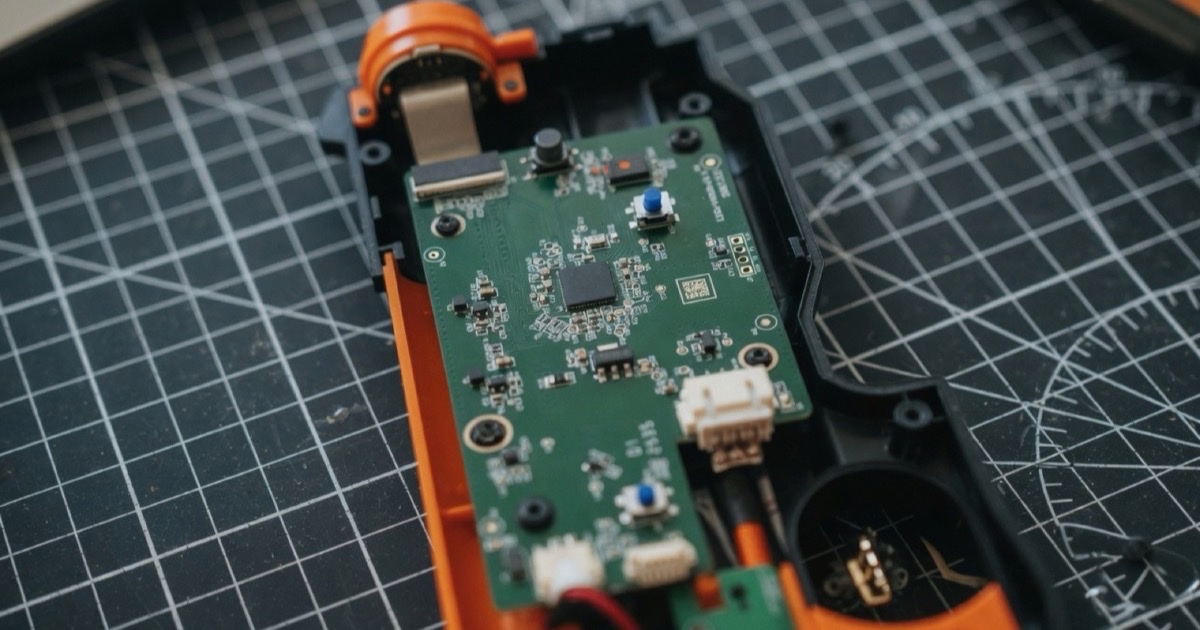
A ¥13,200 Time Crisis console turned out to ship a hardcoded AES key, no secure boot of any kind, and a licensed Namco arcade emulator. The gun turned out to be a second Linux computer with a deliberately unmarked SoC, an NPU, and a root shell on an unpopulated header.
I bought the Japanese retail G’AIM’E TIME CRISIS kit in Akihabara. This is what was inside it — expanded from the thread on Twitter/X.
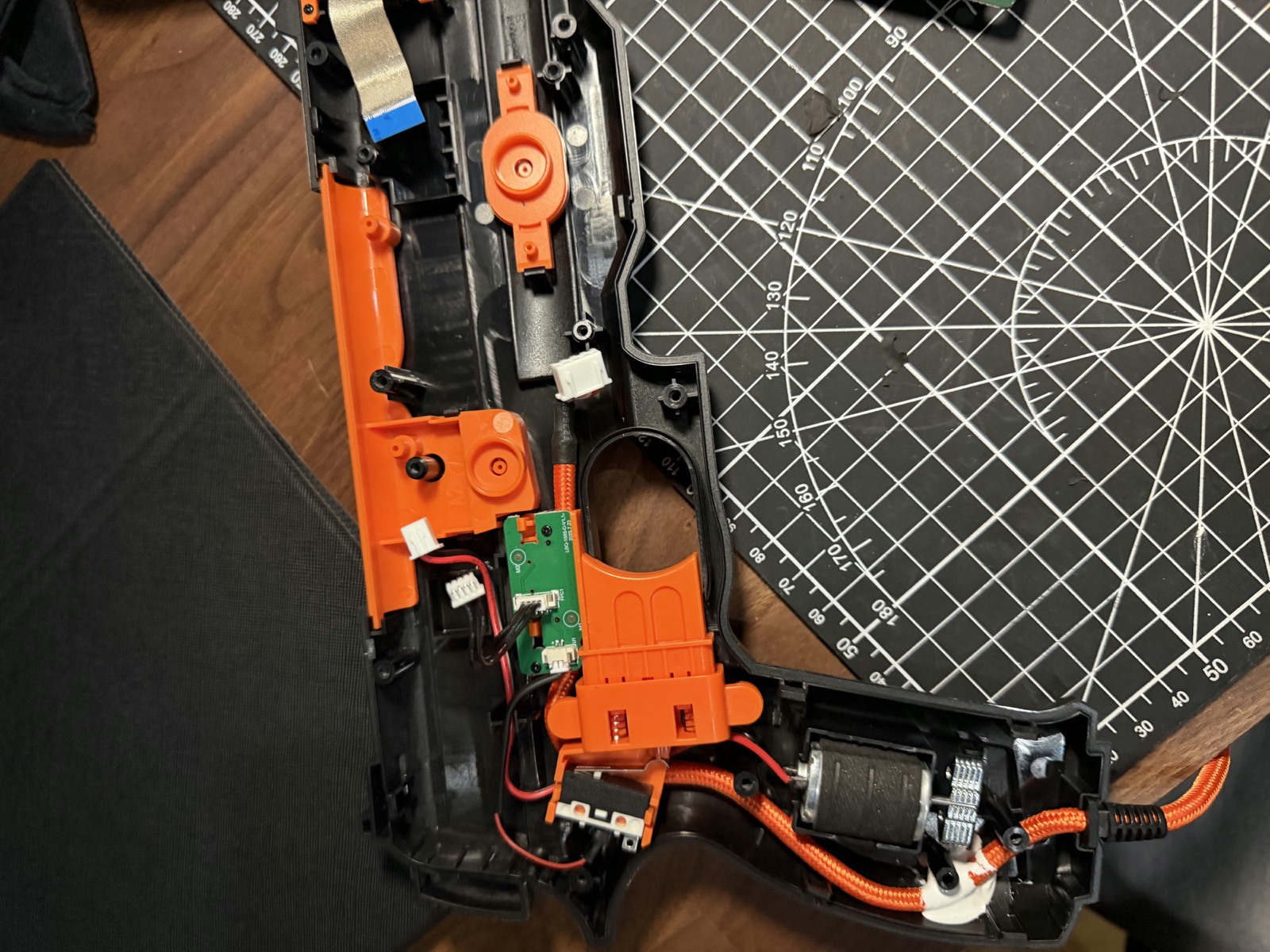 Gun opened: main board, muzzle camera on a ribbon, recoil motor bottom-right.
What it is
G’AIM’E is a small HDMI mini-console from Tassei Denki, licensed by Bandai Namco for the Time Crisis 30th anniversary. You plug in a camera-based light gun, plug in a TV, shoot things. No settings screen, no file manager, no network stack, no way out of the launcher.
Bundles (JP retail): Basic ~¥13,200 (console + 1 gun), Premium (+ pedal), Ultimate (+ second gun). Games: Time Crisis, Point Blank, Steel Gunner / Steel Gunner 2 on the higher SKUs.
Two things made this project unusually productive:
- The vendor publishes a ~4 GB full firmware image as an unauthenticated download — not a delta patch.
- There is no secure boot anywhere in the chain, so once you understand the image you can also put things back.
Everything below used that public download, a USB cable, a cheap serial adapter, and hardware I own. Full notes and tooling live in gaime_mods.
Part 1 — The console
A 4 GB download and a key left in the updater
The update package is a Windows-only vendor tool plus three .dat files. The .dat files start with ASCII magic GAIMEENC and have payload entropy ~7.9998 — genuinely encrypted.
The updater GAIMEUpdater.exe is a .NET 8 single-file bundle. Extracting GAIMEUpdater.dll and decompiling FirmwareDecryptor gives away the scheme, including a hardcoded AES-256-GCM key:
2C4B5B4D84F9A5E0E4D4C2F78B6A1D9E0A0B1C2D3E4F5061728394A5B6C7D8E9
Layout:
"GAIMEENC" (8) · version=1 (1) · max chunk (4, LE = 4 MiB) · base nonce (12)
then repeating { length (4, LE) · ciphertext · GCM tag (16) }

Per-chunk nonce = base nonce with LE int32 at bytes 8..12 XORed with chunk index.
Underneath is a plain Allwinner IMAGEWTY image (PhoenixSuit/LiveSuit container). Re-encrypting an unmodified image reproduces the vendor .dat byte for byte (same SHA-256). At that point the container is solved, not “probably understood.”
What was actually in there
| SoC | Allwinner A527 (sun55iw3), board a527-pro2, octa-core Cortex-A55 |
| DRAM | 512 MiB LPDDR4 |
| Storage | ~58 GiB eMMC |
| OS | Android 13, user build, test-keys |
| Kernel | Linux 5.15.x, built as root@dashine-namco |
| Boot chain | BOOT0 → BL31 (ATF v2.5) → SCP/arisc → U-Boot 2018.07 |
| Board | LBQ-1585-A-V1.1 (2025-07-23) |
| Camera on console | None — zero CSI/MIPI in sys_config.fex |
ODM is Dashine (com.dashine.* packages, leftover Windows build paths in the flasher config).
SKU twist: Basic / Premium / Ultimate are almost the same firmware. Basic just omits three game APKs. Premium vs Ultimate differs by effectively one launcher APK (5 bytes of compression noise). First-launch “authentication” is runtime accessory detection, not separate images.
The emulator is a licensed Namco core, not MAME
Each game is Unity wrapping a native core. Time Crisis uses libSys22Plugin.so, stamped:
(C)2021 BANDAI NAMCO Research Inc.
So this is an in-house Namco System 22 emulator — not FBNeo, not MAME. No GPL leverage, no source offer. The exported API is clean and shipped with debug hooks still present:
Sys22Plugin_SetRom            Sys22Plugin_DebugReadMemory
Sys22Plugin_SetInputPointing  Sys22Plugin_DebugWriteMemory
Sys22Plugin_SetEEPROM         Sys22Plugin_GetForceFeedback
Sys22Plugin_UpdateFrame       …
ROM data is fed via Sys22Plugin_SetRom from C#, living inside a Unity data.unity3d asset rather than loose MAME sets.
Getting in: FEL was hiding in plain sight
Allwinner boot ROM mode FEL speaks a simple USB protocol for memory R/W/X. Entry sequence from the vendor’s own docs: hold the pinhole Programming button, insert USB-C into the rear power jack (power is also data), release after ~5s.
$ sunxi-fel version
AWUSBFEX soc=00001890(A523) …
That independently confirms the sun55iw3 family from a live device.
Hard lesson: reading an unmapped address over FEL hangs the endpoint until a physical replug. Stay in known SRAM until DRAM is up.
Writing a flasher carefully
FEL alone has no eMMC driver. To dump partitions you need Allwinner’s second-stage FES path: load fes1 (DRAM init) → U-Boot (efex) → FES partition commands.
Design choice that kept the unit alive:
- Dumper is read-only by construction — write opcodes are not defined in the read client at all.
- Writer is a separate tool that refuses sectors whose contents match neither the recorded original nor the intended result, and read-backs everything it writes.
The bug that almost ruined the backup: the first full dump looked perfect (right sizes, no errors) and was entirely wrong. GPT LBAs sit 40960 sectors above where FES addresses data. Every partition was read from 20 MiB past the truth. Fix: calibrate against known filesystem magics (ANDROID!, AVB0, …) and refuse to dump if calibration fails.
Result: full 27-partition backup of factory firmware older than the public download — something one OTA would have destroyed.
No secure boot. Anywhere.
| Check | State |
|---|---|
| Secure boot fuse | clear |
| AVB | vbmeta flags zero; “avb” never appears in boot log |
| dm-verity | not enforcing |
| Integrity | 32-bit word sum on some images |
UART and the one-byte ADB trap
Three unpopulated headers on the board, silkscreened: J2 = UART (GND/TX/RX), J3 = JTAG, J4 = grounds. SW1 is literally labeled FEL.
Serial at 115200 gave a full boot log and a root shell. Then logcat explained why five carefully verified patches to enable ADB did nothing:
adbd: Could not set SELinux context
Our own ro.secure=0 patch was the problem. On a user build, adbd tries a transition to u:r:su:s0 that policy denies — so adbd fatals forever. Forcing service.adb.root=0 fixed it. Four correct patches had been masked by one wrong assumption.
With adb working, the kiosk is just a door: 106 packages, 24 launchable activities, including stock Settings. Small APKs installed to /data (hello splash + file explorer) cannot affect boot and uninstall cleanly.
Part 2 — The gun (the more interesting half)
Five USB interfaces, one of them is a gift
VID 0x2E2C PID 0x0631 — Tassei Denki / GAIME v1
| # | Class | Role |
|---|---|---|
| 0 | HID | Boot keyboard |
| 1 | HID | Digitizer — absolute pointer |
| 2 | HID | Vendor config (64-byte, Modbus CRC-16) |
| 3–4 | UVC | “Dashine UVC” camera gadget |
Interface 1 is a Touch Screen digitizer: tip switch (trigger), “in range”, X/Y as absolute 0–10000. That is exactly what light guns need — plug into any PC and you get an absolute mouse with no vendor software.
All CV runs in the gun. The console has no camera. For pointing, the console is optional: this is effectively a Sinden-class gun at a fraction of Sinden’s price.
Measuring the jitter everyone complains about
Reviews mention pointer jump on trigger. Ten seconds of capture with the gun on a desk (not aimed at a display):
- Report rate wildly variable (~28–278 Hz)
- X/Y span the full 99–9900 clamp range
- Mean jump ~90 counts; worst jump ~half the screen in one report
in_rangewas set on every single garbage report — useless as a validity gate
So filtering has to be geometric (median-of-5 + max-jump), not flag-based. On macOS the digitizer hijacks the system cursor; gun_bridge.swift seizes the device (kIOHIDOptionsTypeSeizeDevice) and only re-emits while RetroArch (or another app) is frontmost.
The UVC stream is a test pattern
The gun enumerates UVC up to 1080p. Captured frames are not imagery — a synthetic ramp:
- every row perfectly uniform in X (σ = 0)
- scrolls at exactly +1.6 rows/frame
- bit-identical after roll offsets (zero sensor noise)
Looks like a bring-up leftover that shipped inactive. Console code never consumes video.
Opening the gun
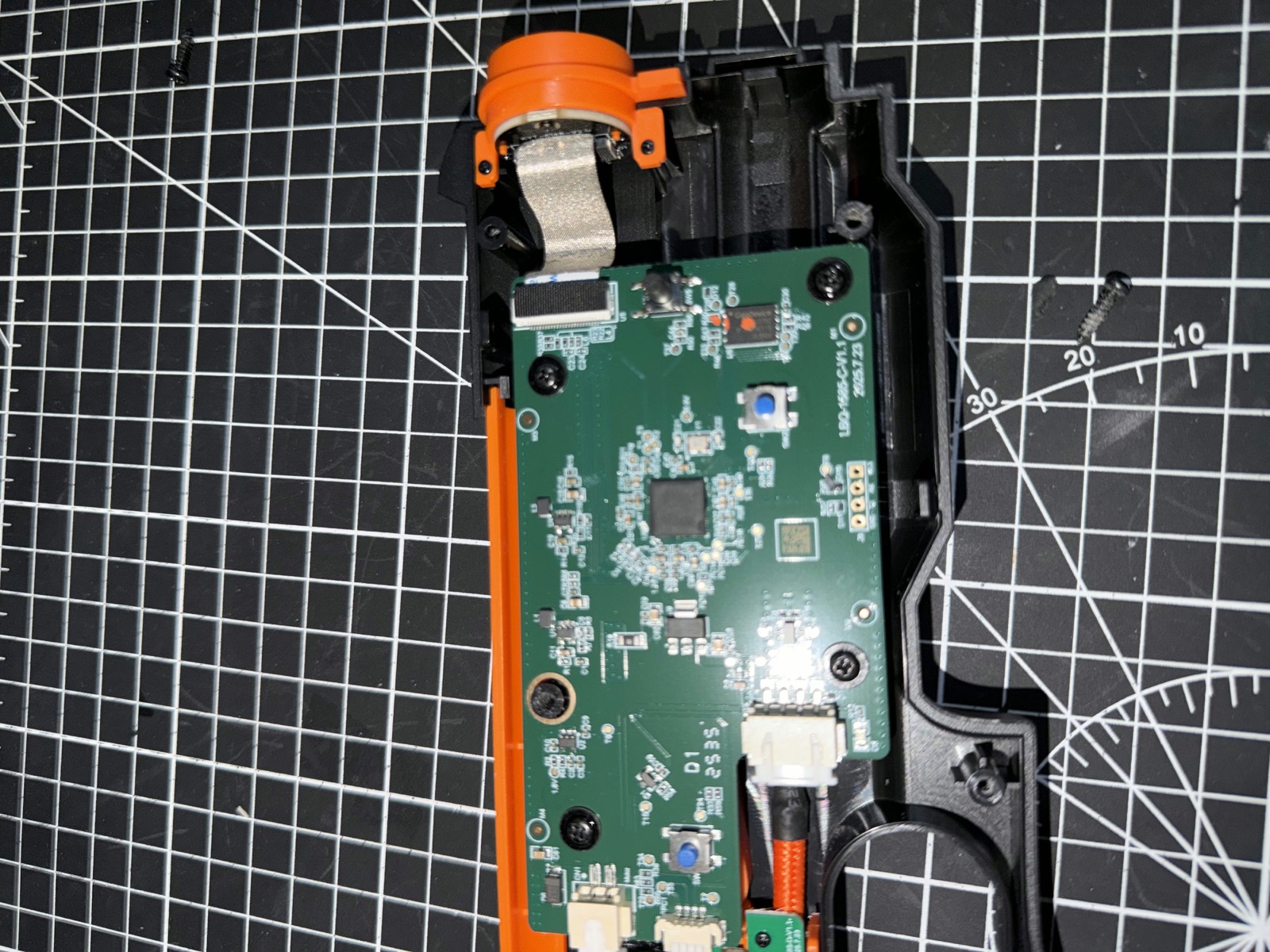 Main board
 LBQ-1585-C-V1.1 — note blank SoC at U8 and serial header J3.
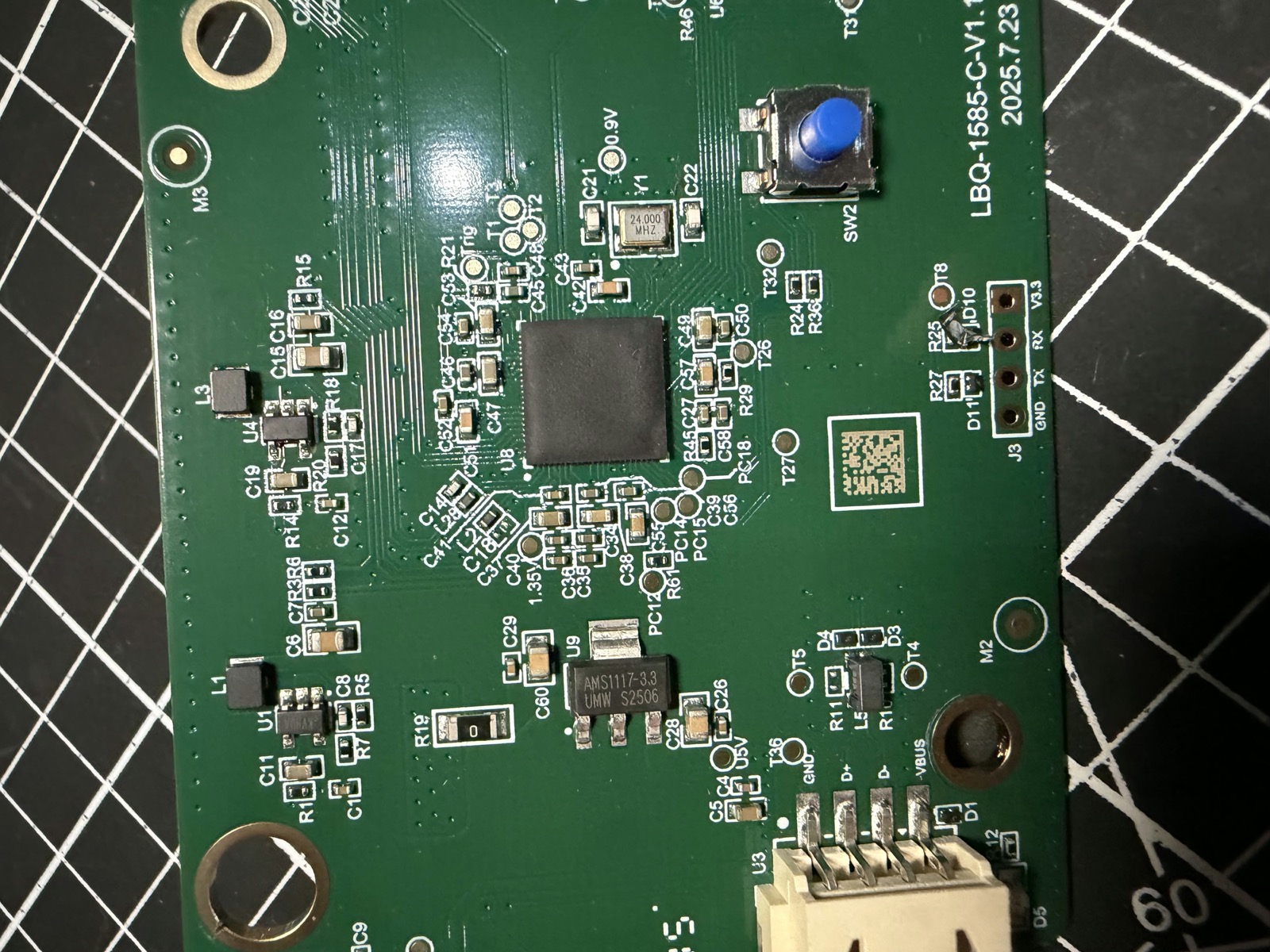 Unmarked ~96-pin QFN at U8; J3 silkscreened GND / TX / RX / V3.3.
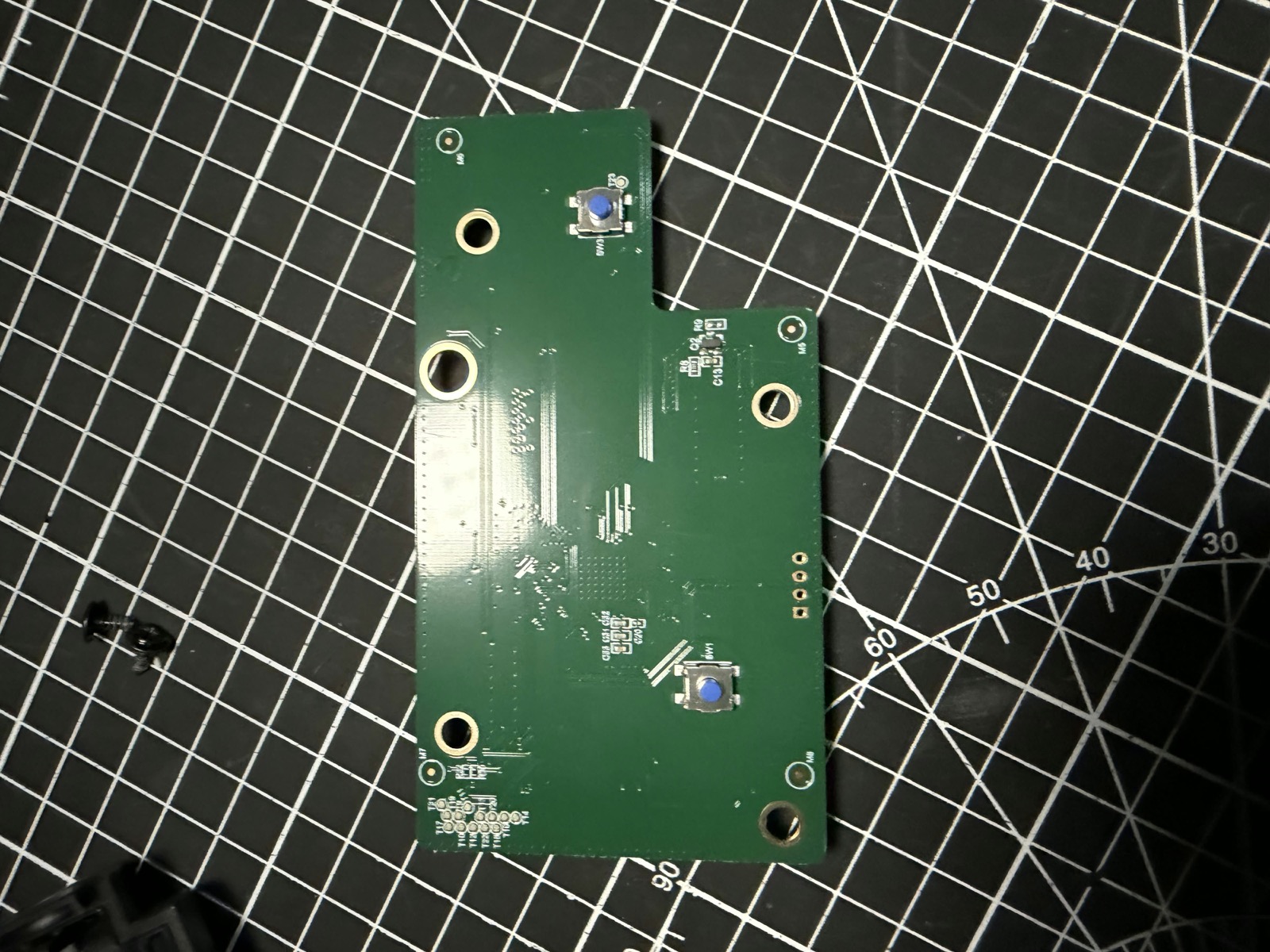 Nearly bare reverse — no external DRAM; memory is in-package.
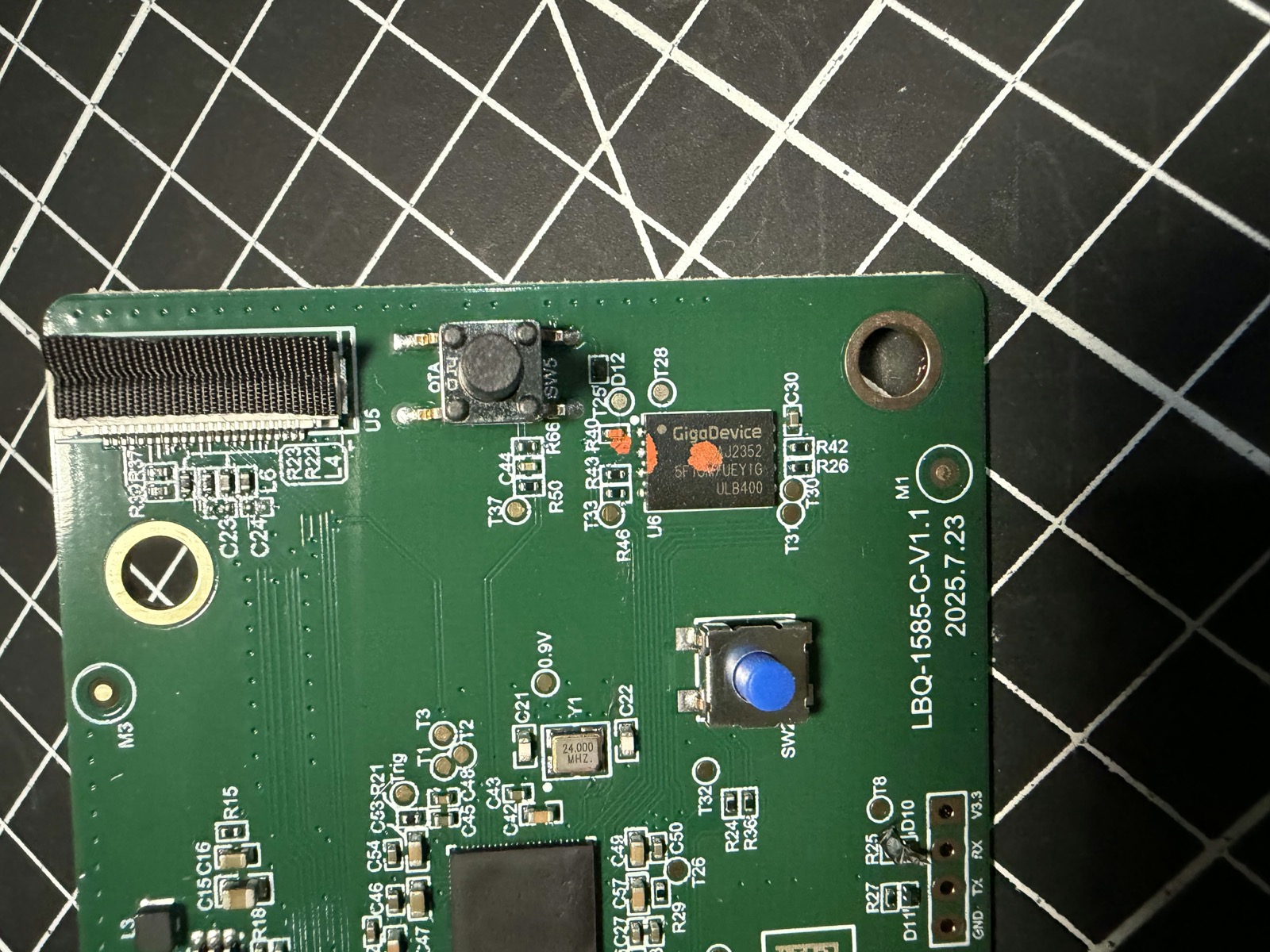 SPI NAND near the camera end; camera module on its own FPC in the barrel.
PID 0x0631 is 1585 decimal — same project number as the board silk. Boot medium is a GigaDevice SPI NAND (not NOR — clips and flashrom won’t help). DRAM is stacked in-package.
Three wires and a root shell
Receive-only on J3 first (can’t brick). After fixing two self-inflicted issues (unpowered gun → EMI garbage; a leftover uart_watch.sh still stealing half the bytes), one newline was enough:
# id
uid=0(root) gid=0(root) groups=0(root),10(wheel)
Root, no password. Boot log even shows Starting telnetd: OK — just no network interface for it to listen on.
The blank chip has a name: LomboTech N7V5
Kernel strings and props give it away:
ro.product.chip=n7v5
ro.product.name=n7v5_alcor_lightgun
ro.build.user=dashine
ro.build.host=gaime-gun-001
Same ODM as the console. Cortex-A7 class Linux box, ~128 MiB RAM visible to Linux, NPU for the aim model. CV path runs 224×224 @ 60 fps into an NN — not a 1080p pretty stream. Camera source is /dev/video3 only after libvideo brings the ISP pipeline up.
There is no USB DFU path from the host; the console never ships gun firmware blobs. Inside the rootfs, fw_upgrade / fw_ab_upgrade exist but nothing over USB invokes them from the console side.
What’s open
- Permanent one-byte ADB property fix on the console (button snapped during teardown — FEL still works)
- Namco System 22 debug hooks and the Unity ROM asset
- Real camera frames out of the gun (need clean shutdown of vendor
gunprocess + libvideo bridge; abrupt kill reboots the box) - In-circuit SPI NAND dump via the SoC once UART is the daily driver
Tooling (safe by construction)
Decrypt/encrypt GAIMEENC, IMAGEWTY unpack, sparse/lpunpack, read-only FES dumper, gated FES writer, UART shell, gun HID probe, macOS gun bridge — all in the repo.
Bottom line
| Half | Surprise |
|---|---|
| Console | Android 13 Allwinner kiosk, public AES key, no secure boot, licensed System 22 core |
| Gun | Separate LomboTech N7V5 Linux + NPU, absolute HID, root on J3, UVC is a fake pattern |
If you only want a cheap absolute light gun for RetroArch/MAME, the gun already works on a PC — just filter the jitter and seize the digitizer on macOS.
Not affiliated with Tassei Denki, Bandai Namco, or Dashine. Device-unique IDs redacted; game ROMs not republished.
Code & full lab notes: github.com/mattkanwisher/gaime_mods
Originally sketched as short posts on X: console open · gun teardown.